






Machine Learning-Based Headache Classification Studied in Boğaziçi University DSAI Master's Thesis
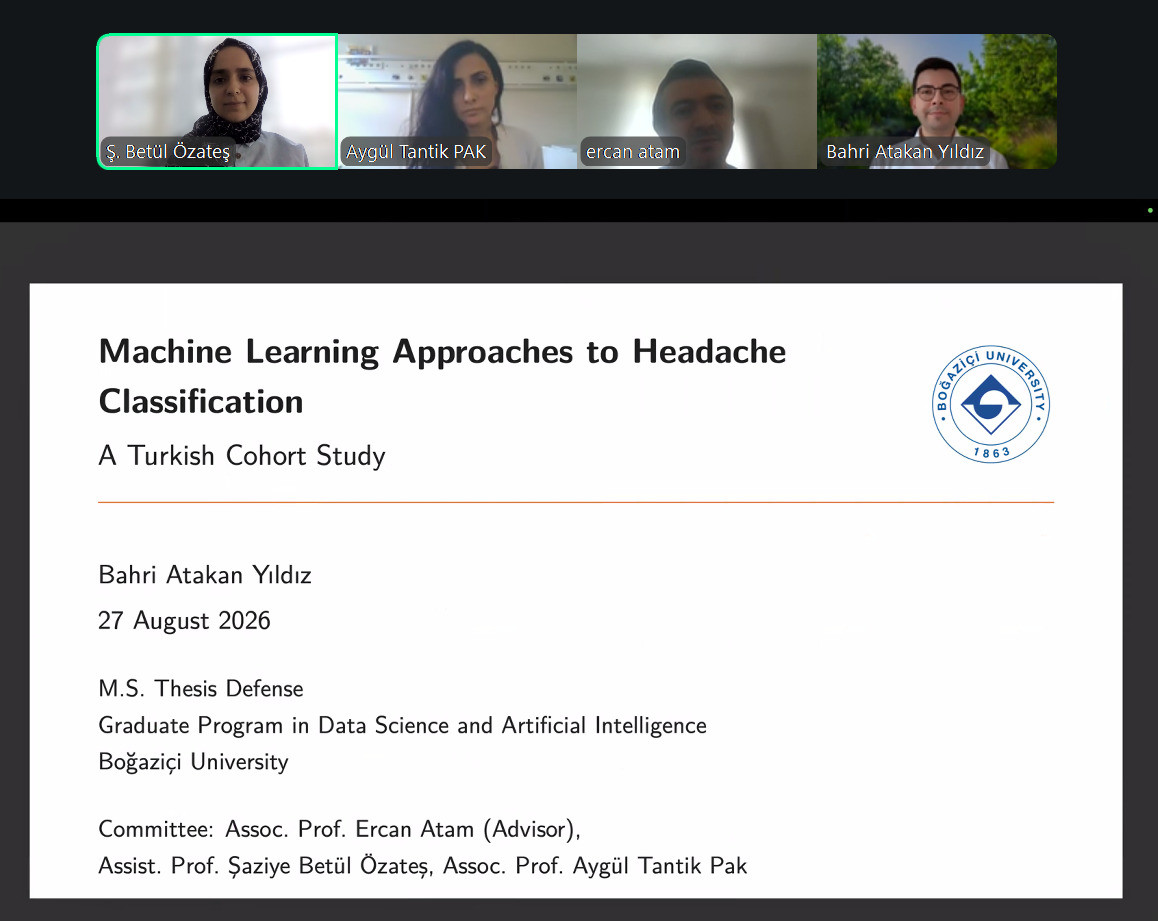
Headache disorders are a major cause of disability and accurate classification is important for clinical assessment and management. In his master’s thesis, Bahri Atakan Yıldız, a graduate student at Boğaziçi University’s Data Science and Artificial Intelligence (DSAI) Institute, studied machine learning approaches for reproducing neurologist-assigned headache labels from structured questionnaire data. The thesis was supervised by Ercan Atam.
The thesis, titled “Machine Learning Approaches to Headache Classification: A Turkish Cohort Study,” uses data from 405 adults recruited at the neurology clinic of Gaziosmanpaşa Training and Research Hospital in Istanbul. Each patient record included responses to a 24-item Turkish headache questionnaire and a neurologist-assigned ICHD-3 code. Six classifiers—Logistic Regression, Decision Tree, Random Forest, XGBoost, TabPFN-3, and TabFM—were compared in a binary task distinguishing migraine from tension-type headache (TTH) and a three-class task that additionally included other headache diagnoses.
The results show that the pretrained TabFM model achieved the highest mean macro-F1 score in both tasks: 0.914 for migraine-versus-TTH classification and 0.813 for the three-class problem. An XGBoost SHAP analysis identified untreated attack duration as the feature with the largest mean absolute contribution across all three class outputs, with different response patterns for migraine and TTH. The findings demonstrate the potential of modern tabular machine learning models for headache-label classification from structured clinical questionnaires, while also emphasizing the need for external validation before broader clinical use.
We congratulate Bahri Atakan Yıldız on successfully completing his master’s thesis and wish him continued success in his academic and professional life.
