






Dr. Muhammed Göleç Publishes New Research on Tiny LLMs and Edge-Oriented Load Forecasting
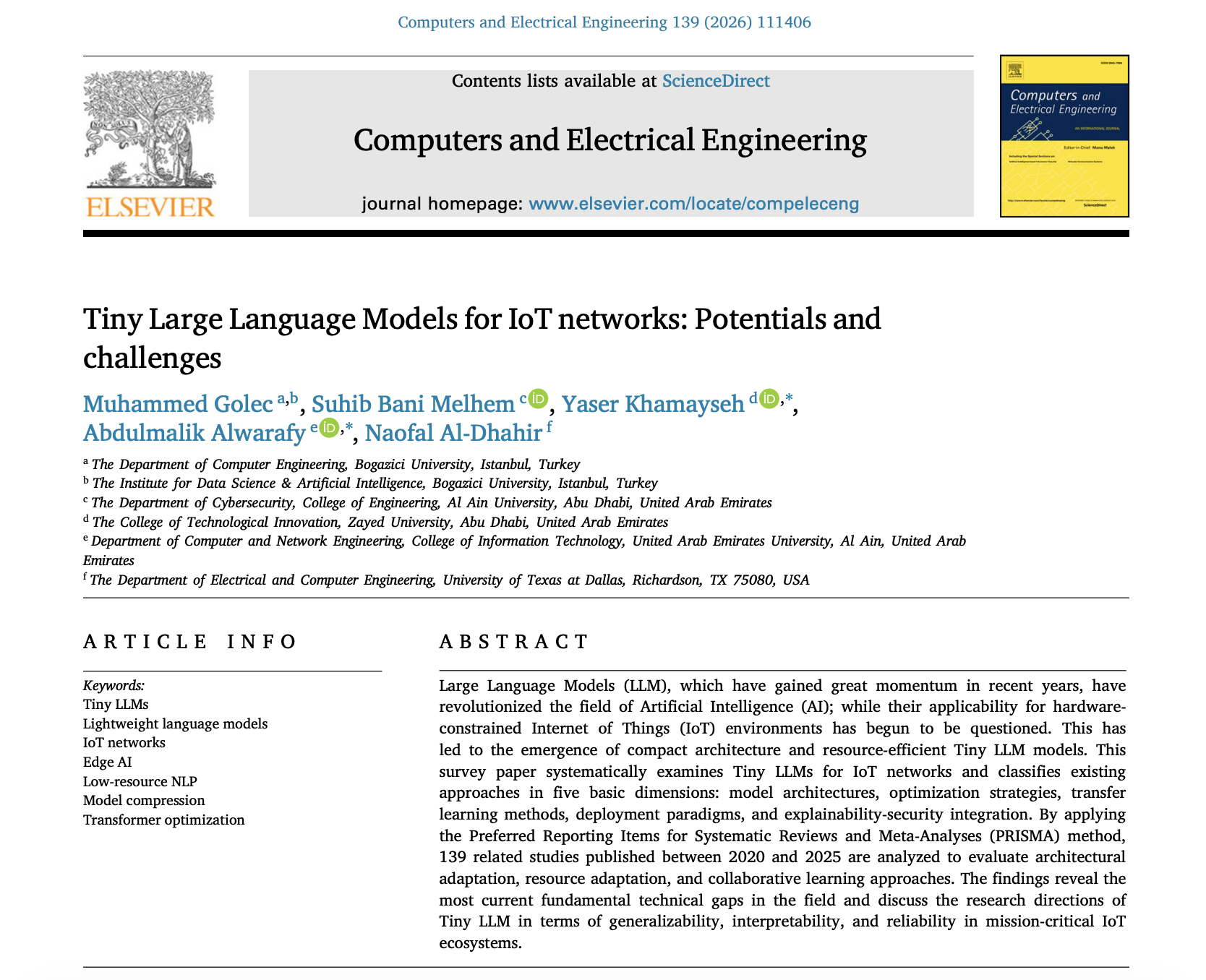
Dr. Muhammed Göleç, an affiliated faculty member at the Institute for Data Science & Artificial Intelligence, has published two first-author studies focusing on artificial intelligence solutions for resource-constrained and edge computing environments. His article, “Tiny Large Language Models for IoT Networks: Potentials and Challenges,” published in the Q1 journal Elsevier Computers & Electrical Engineering, presents a systematic review of 139 studies published between 2020 and 2025. Following the PRISMA methodology, the study examines Tiny LLM architectures, optimization and transfer-learning methods, deployment strategies, explainability, and security, while identifying research gaps concerning the generalizability, interpretability, and reliability of these models in mission-critical IoT systems. His second paper, “TAM: Temporal Attention for Edge-Oriented Short-Term Load Forecasting,” presented at IEEE CCECE 2026, introduces a Temporal Attention Mechanism integrated into an ESN–GRU-based architecture. Experiments using real-world electricity consumption data demonstrate a 12% improvement in RMSE and an increase in the R² score from 0.953 to 0.964. Evaluations conducted on Raspberry Pi 4 and cloud platforms further show that the proposed approach improves forecasting accuracy with only a limited increase in energy consumption, supporting its suitability for edge-based energy applications.
