






BUCIS Lab Researchers Develop a Novel AI-Based Approach to Function Approximation
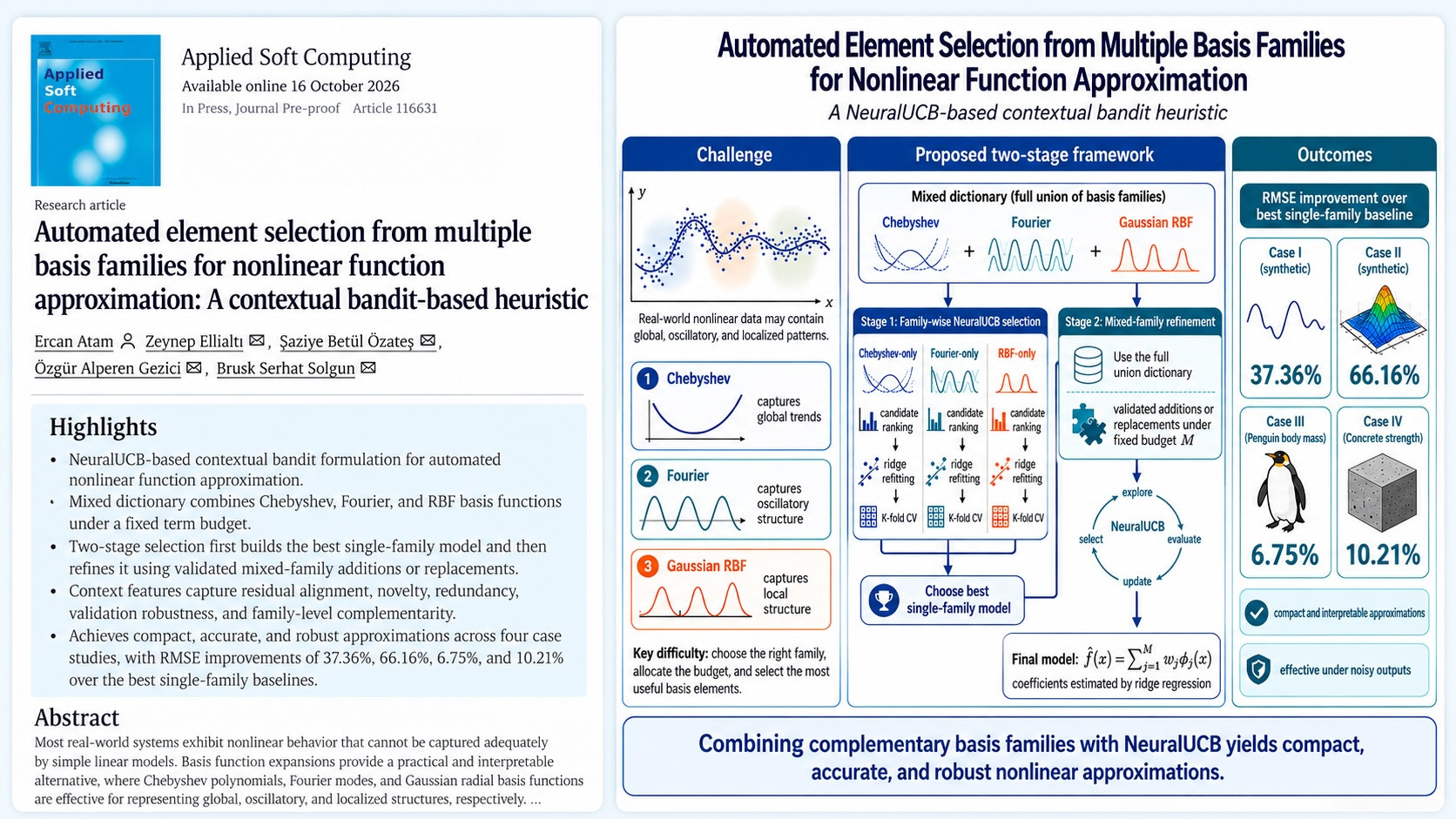
Researchers from BUCIS Lab have developed a new artificial intelligence-based framework for automated nonlinear function approximation. The study, titled “Automated Element Selection from Multiple Basis Families for Nonlinear Function Approximation: A Contextual Bandit-Based Heuristic,” was conducted by Ercan Atam, Zeynep Ellialtı, Şaziye Betül Özateş, Özgür Alperen Gezici, and Brusk Serhat Solgun.
The proposed approach addresses a fundamental challenge in nonlinear modeling: determining which basis functions should be used to represent complex nonlinear relationships. Instead of relying on a single basis family, the framework combines three complementary families—Chebyshev polynomials, Fourier functions, and Gaussian radial basis functions (RBFs)—which are particularly suited to capturing global trends, oscillatory behavior, and localized nonlinear structures, respectively.
As illustrated in the graphical abstract, the method uses a NeuralUCB-based contextual multi-armed bandit to automatically identify useful basis elements while considering information such as residual alignment, novelty, redundancy, validation robustness, and complementarity among basis families. Candidate basis elements are treated as context-dependent arms, allowing the method to balance exploitation of promising candidates with exploration of uncertain but potentially useful alternatives.
The framework follows a two-stage selection strategy. In the first stage, NeuralUCB independently constructs Chebyshev-only, Fourier-only, and RBF-only models, and the strongest single-family approximation is selected using cross-validation. In the second stage, the search is expanded to the full union dictionary. The algorithm then refines the selected model through validated additions or replacements while strictly maintaining a fixed basis-function budget. Model coefficients are estimated using ridge regression, helping preserve numerical conditioning and control model complexity.
This design allows different basis families to contribute where they are most effective: Chebyshev terms can represent global algebraic trends, Fourier terms can efficiently capture periodic or oscillatory behavior, and Gaussian RBFs can model localized structures. By combining these complementary representations within a single automated selection framework, the method aims to obtain compact and interpretable approximations without forcing one basis family to model every type of nonlinear behavior.
Experiments on four nonlinear approximation problems—including synthetic and real-life regression cases—demonstrate the benefit of the mixed-family strategy. Relative to the best single-family baselines, the proposed framework achieved RMSE improvements of 37.36%, 66.16%, 6.75%, and 10.21% across the four case studies. The results also show that the method can produce compact, accurate, and robust approximations and remains effective under noisy-output conditions.
The work has been accepted for publication in Applied Soft Computing, a leading journal in the fields of artificial intelligence, computational intelligence, and soft computing.
For further details, please visit:
https://www.sciencedirect.com/science/article/abs/pii/S156849462602079X