






Boğaziçi University DSAI Master's Thesis Explores AI-Based Cognitive Forecasting for Early Dementia Monitoring
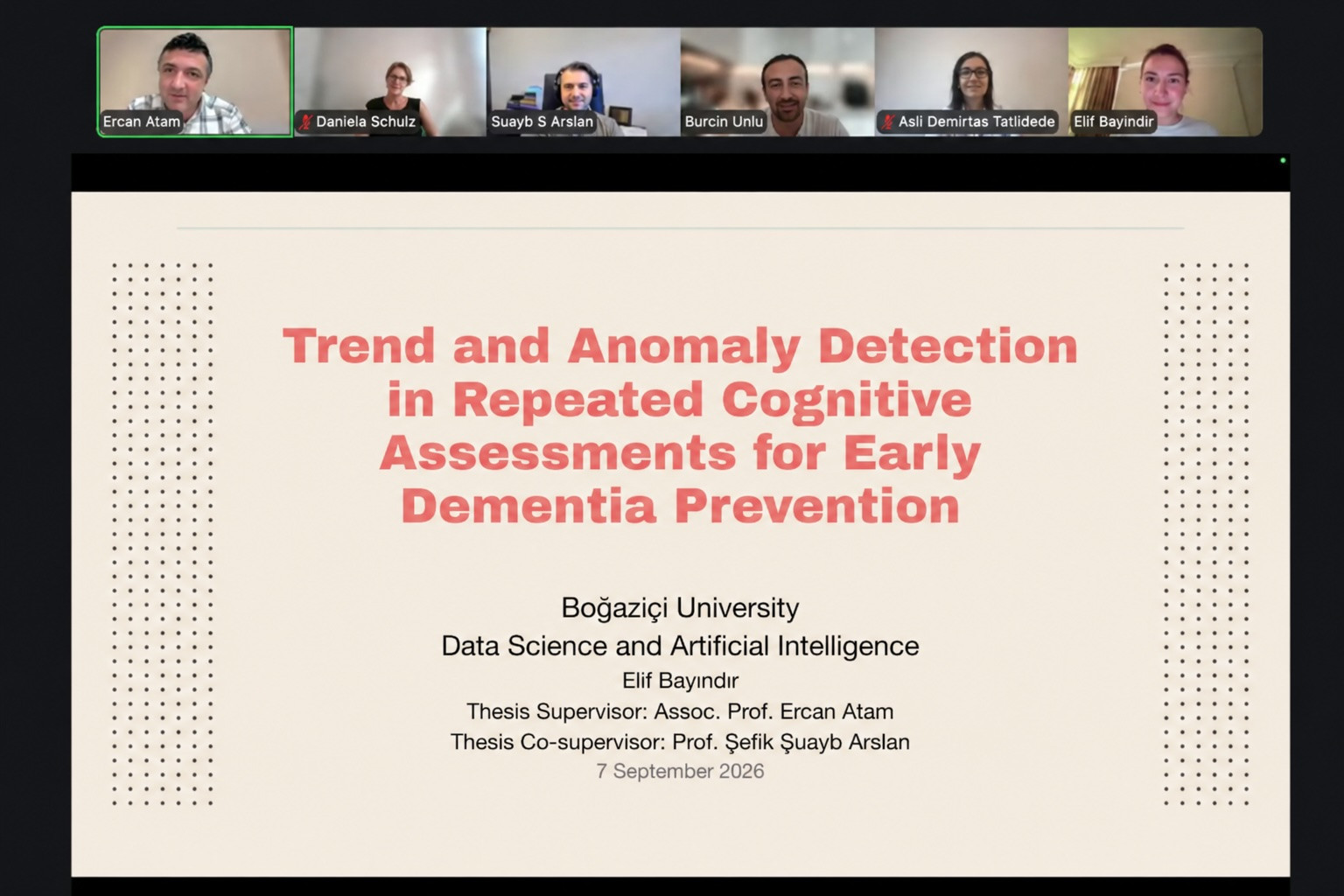
Early detection and continuous monitoring of cognitive decline are increasingly important for supporting dementia prevention and clinical decision-making. In her master’s thesis, Elif Bayındır, a graduate student at Boğaziçi University’s Data Science and Artificial Intelligence (DSAI) Institute, studied AI-based methods for forecasting cognitive performance and detecting unusual changes in longitudinal digital cognitive assessments. The thesis was supervised by Ercan Atam and co-supervised by Şefik Şuayb Arslan.
The thesis, titled “Trend and Anomaly Detection in Repeated Cognitive Assessments for Early Dementia Prevention”, analyzes 23,994 assessment cycles collected from 3,283 users of the Beynex digital cognitive health platform. The study focuses on the Beynex Performance Index (BPI), a composite measure of cognitive performance, and compares seven forecasting approaches at prediction horizons ranging from 1 to 30 assessment cycles. The evaluated methods include statistical forecasting techniques, tree-based machine-learning models, and TabPFN-2, a pretrained tabular foundation model adapted for time-series forecasting.
The results show that more complex models provided only limited improvements in short-term point prediction accuracy, while clearer differences emerged in the models’ ability to represent predictive uncertainty. Random Forest maintained prediction-interval coverage close to 90% across different forecast horizons, while TabPFN-2 Extended was closest to the target coverage at the longest horizon. Simple Exponential Smoothing achieved the lowest point and distributional errors at the 30-cycle horizon, whereas TabPFN-2 Extended performed better than Random Forest in user-level comparisons.
The thesis also introduced an anomaly-screening analysis for identifying cognitive measurements that deviate substantially from an individual’s previous performance pattern. Among 9,187 evaluated measurements, 355 were flagged as unusual. The findings demonstrate that continuous digital cognitive monitoring can provide not only an expected future score but also an estimate of the uncertainty surrounding that prediction. Such information may help neurologists distinguish normal within-person variability from potentially important cognitive changes and may contribute to periodic screening and monitoring in aging, cognitive impairment, and dementia-related care.
We congratulate Elif Bayındır on successfully defending her Master’s thesis and wish her continued success in her academic and professional career.