





AI-Based Earthquake Protection of Buildings Studied in Boğaziçi University DSAI Master's Thesis
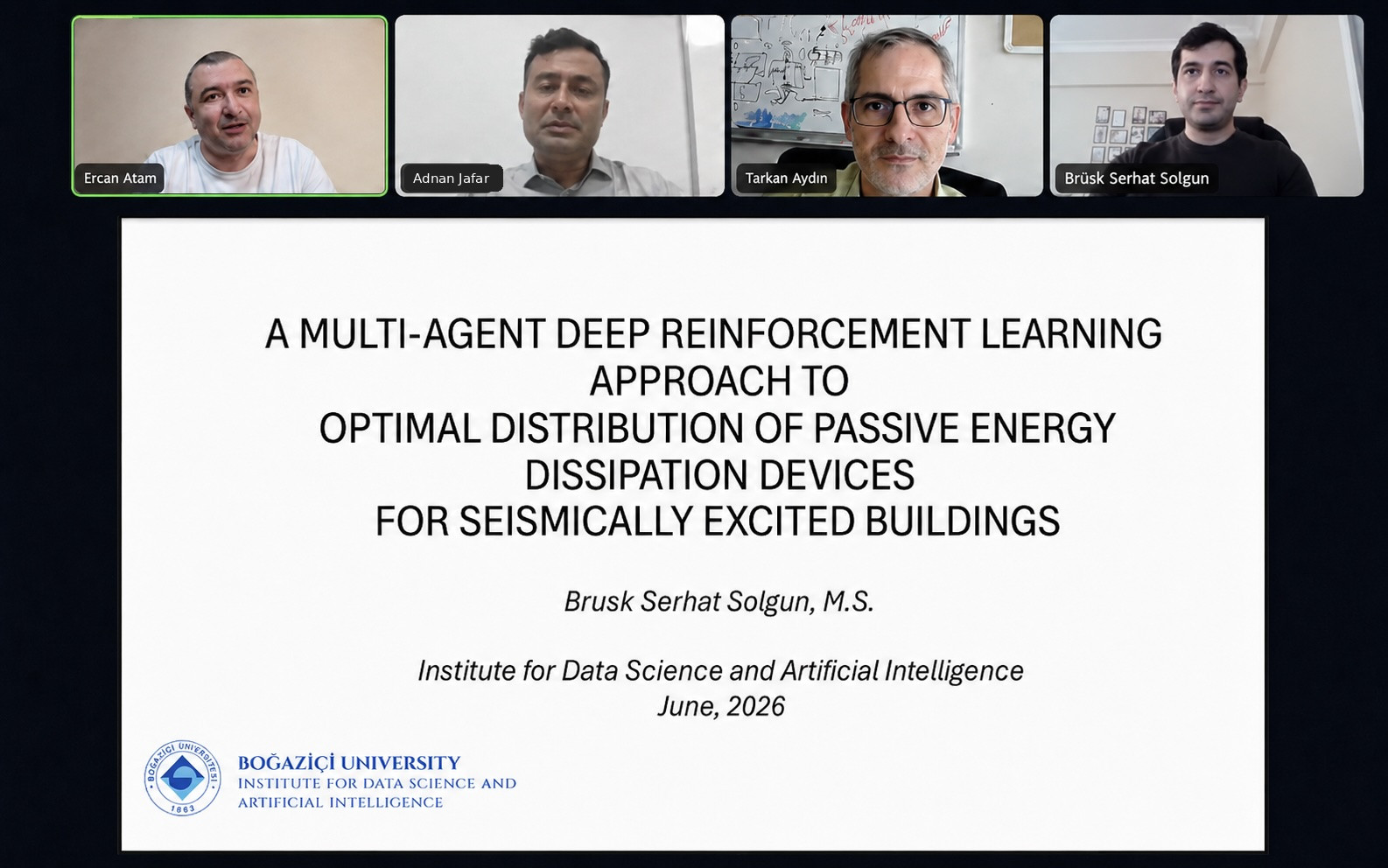
Earthquakes pose a major risk for buildings, especially in earthquake-prone countries such as Türkiye. In his master’s thesis, Brüsk Serhat Solgun, a graduate student at Boğaziçi University’s Data Science and Artificial Intelligence (DSAI) Institute, studied AI-based methods for improving the seismic performance of buildings. The thesis was supervised by Ercan Atam.
The thesis, titled “A Multi-Agent Deep Reinforcement Learning Approach to Optimal Distribution of Passive Energy Dissipation Devices for Seismically Excited Buildings,” focuses on the optimal distribution of viscous dampers, which help buildings absorb and dissipate earthquake energy. The study formulates this problem as a multi-agent deep reinforcement learning task and evaluates two methods, MAPPO and QMIX, on a three-storey reinforced concrete building model subjected to earthquake ground motions.
The results show that AI-based multi-agent learning can identify effective damper distributions and reduce structural response, particularly inter-storey drift, an important indicator of earthquake damage. The study highlights the potential of artificial intelligence to support safer, more scalable, and more resilient building design and retrofitting strategies in Türkiye.
