






From Wearable Sensing to Context-Aware Intelligence: Designing Human-Centered Systems
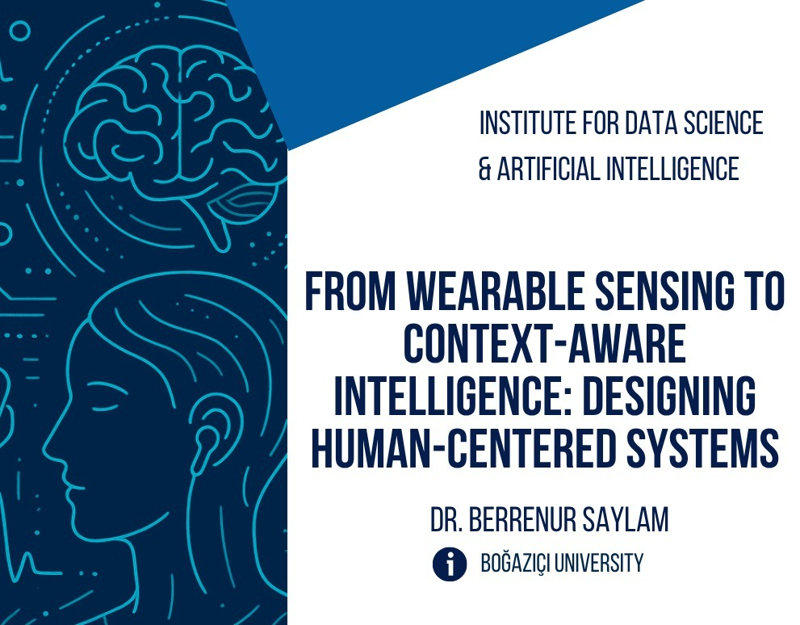
Speaker: Dr. Berrenur Saylam
Bio: Berrenur Saylam is a computer scientist with an interdisciplinary background spanning Computer Engineering, Industrial Engineering, and Complex Systems. She holds a Ph.D. in Computer Engineering from Boğaziçi University, where her research focused on developing machine learning models for mental health assessment using data collected from wearable technologies. Her research lies at the intersection of artificial intelligence, human-computer interaction, and digital health, with a focus on multimodal learning, graph-based modeling, and human-centered system design. She works on integrating physiological, behavioral, and textual data to build adaptive and context-aware computational models.
Dr. Saylam received her academic training at Galatasaray University and ENS de Lyon, and has held visiting research appointments in European laboratories. Her research interests include affective computing, wearable and ubiquitous technologies, and the development of socially responsible, interpretable AI systems for well-being support.
Abstract: As wearable technologies continue to advance, they offer new opportunities to monitor and support individual well-being through continuous, unobtrusive sensing in real-world settings. This seminar focuses on the design of human-centered systems that utilize multimodal signals such as physiological data and behavioral indicators collected via wearable sensors to assess mental and emotional states over time.
The presentation explores how longitudinal sensor data can be used to model temporal patterns related to stress, affect, and broader psychological states, moving beyond short-term assessments to capture changes unfolding across days, weeks, or months. Key challenges in this domain include ensuring the interpretability of predictive models, integrating multiple dimensions of well-being, and aligning computational features with established psychological frameworks.
Methodological approaches such as time-series analysis, multitask learning, and hybrid modeling will be discussed, with particular attention to how digital biomarkers and feature importance measures can provide actionable and explanatory insights. By identifying both momentary states and longer-term trajectories, these systems aim to support early detection and intervention in mental health contexts.
Together, the presented work outlines a direction for building context-aware systems that are not only technically robust, but also aligned with the complexities of human experience and the practical demands of real-world deployment.
We look forward to seeing you there!
