





From AI-Assisted Development to Autonomous Software Systems: Sustainability, Explainability, and Self-Improving Systems
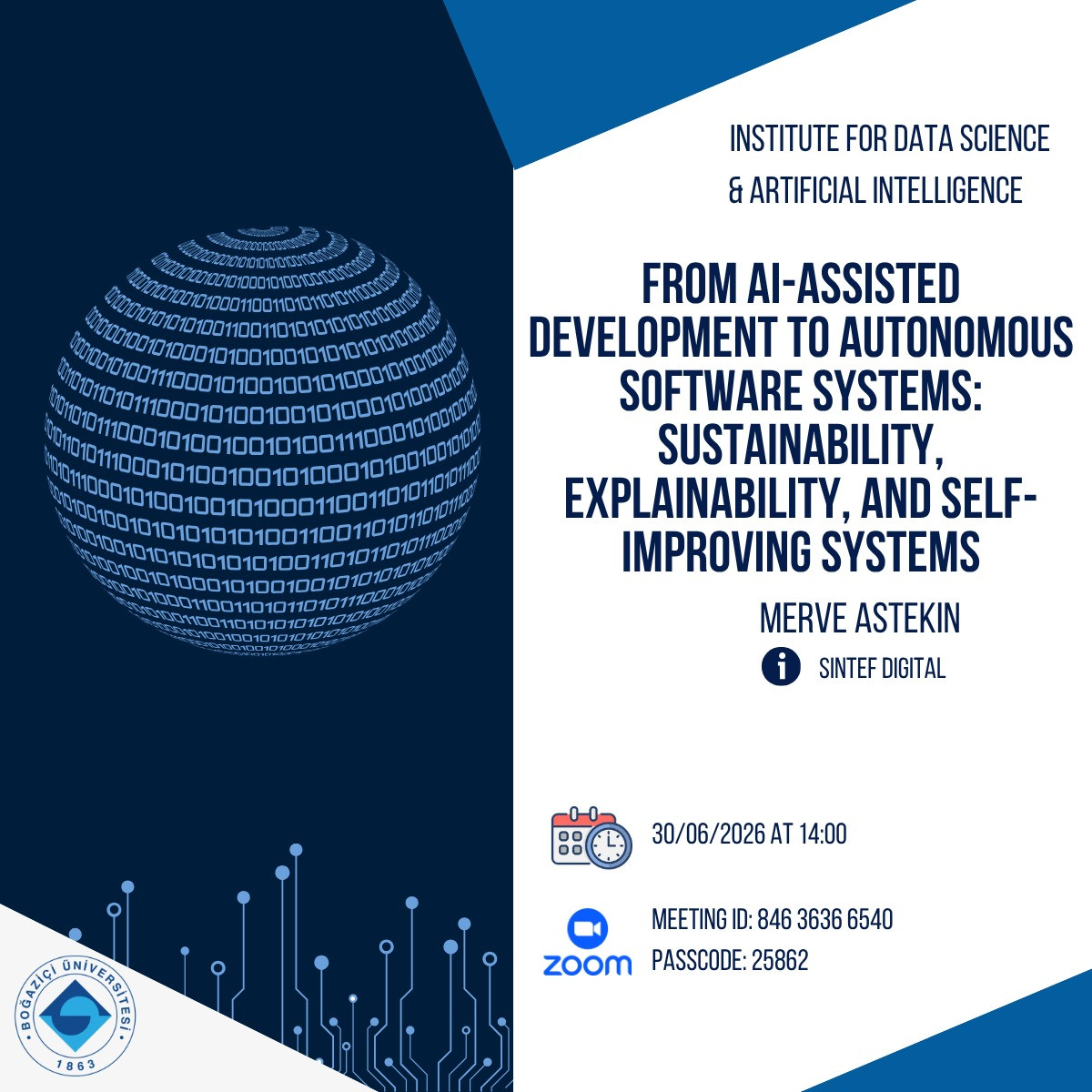
Speaker: Merve Astekin
Abstract: Large Language Models (LLMs) and AI agents are rapidly transforming software engineering, enabling new approaches to software maintenance, code analysis, vulnerability detection, system monitoring, and automated decision-making. As software systems become increasingly capable of performing complex engineering tasks, an important question emerges: how can we build software systems that are not only intelligent but also trustworthy, sustainable, explainable, and capable of self-improvement? In this talk, I will present a research journey toward increasingly autonomous software systems through a collection of recent studies at the intersection of software engineering and AI. I will begin with an AI-assisted software engineering approach for detecting technical debt and discuss how such capabilities can support software quality and reliability. I will then explore the transition from single-model solutions to agentic software engineering and a comprehensive empirical study of agentic LLM systems across software engineering tasks such as code generation, technical debt detection, vulnerability detection, and log analysis. These studies reveal important trade-offs between accuracy, latency, and energy consumption, highlighting the sustainability challenges introduced by increasingly autonomous AI workflows. Building on this foundation, I will discuss two complementary directions addressing key requirements for trustworthy autonomous systems. First, I will present a multi-agent framework designed to generate human-understandable explanations for intent-based system management. Second, I will introduce an adversarial self-play approach in which AI agents continuously challenge and improve software validation capabilities, demonstrating the potential for self-improving software engineering tools. Together, these efforts illustrate several building blocks required for future autonomous and self-healing software systems, including automated detection, explainability, repair guidance, self-improving capabilities, and sustainability-aware operation. The talk concludes with a discussion of open research challenges and future directions for engineering software systems that can increasingly understand, explain, and improve themselves while remaining trustworthy and energy-efficient.
Bio: Merve Astekin is a Research Scientist at SINTEF Digital, Norway, where she conducts research on trustworthy, sustainable, and autonomous software systems. Her work spans AI for Software Engineering (AI4SE), trustworthy and green AI, and self-healing software systems, with a focus on Large Language Models (LLMs) and intelligent agents for software development and operations. She currently contributes to several European research initiatives on trustworthy and sustainable AI, including work on energy-efficient AI systems, autonomous software engineering agents, and software resilience. Her recent research investigates the effectiveness, efficiency, and environmental impact of LLMs in software engineering tasks, as well as AI-driven approaches for software maintenance, reliability, and self-adaptation. Prior to joining SINTEF, she was a postdoctoral fellow at Simula Research Laboratory in Norway and a senior researcher and project manager at TÜBİTAK BİLGEM in Türkiye, where she contributed to large-scale R&D projects in software quality, cloud computing, and data-intensive systems. She holds a Ph.D. in Computer Science from Özyeğin University and B.Sc. and M.Sc. degrees in Computer Engineering from Istanbul Technical University.
https://us06web.zoom.us/j/
MEETING ID: 84636366540
PASSCODE: 25862
