





Advancements in One-Class Classification for Face Presentation Attack and Deepfake Detection
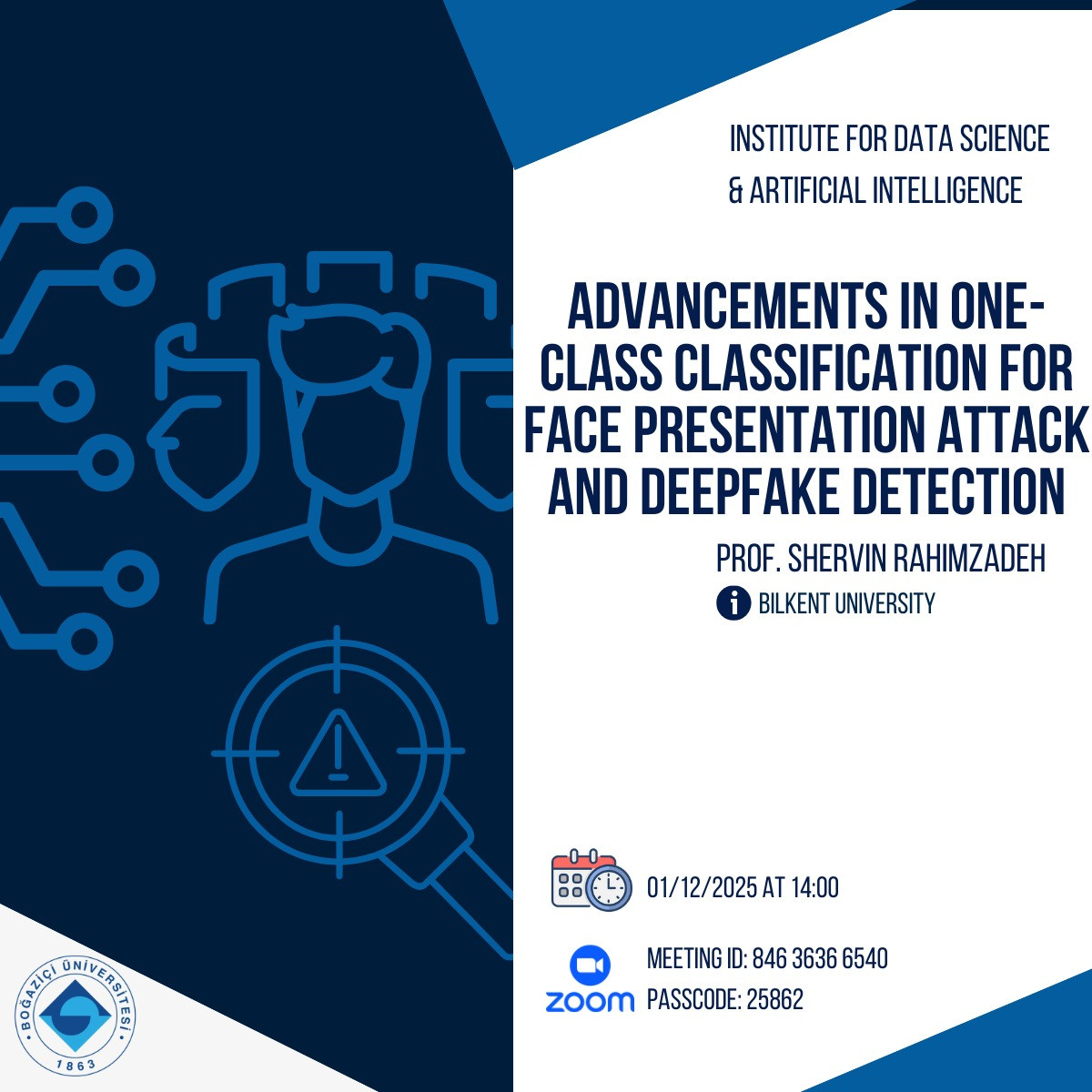
Speaker: Prof. Shervin Rahimzadeh - Bilkent University
Abstract: This talk, after a brief review of unconstrained face recognition, delves into the latest research and advancements in the field of face spoofing and deepfake detection, specifically utilizing One-Class Classification (OCC) techniques. Face recognition systems face significant challenges from presentation attacks and deepfake manipulations, which pose serious security risks across various domains. Traditional two-class classifiers often struggle with the high cost of sample collection and inability to generalize well to unseen attack types. In contrast, One-Class Classification approaches are able to solely learn from genuine data, offering a more robust solution to detect novel attacks and deepfakes. The talk covers some of our main contributions in these domains, including client-specific modeling, kernel fusion, large-margin classification, and sparsity-induced classifier combination. Real-world performance evaluations on multiple real-world datasets demonstrate the efficacy of the developed techniques in both face presentation attack and deepfake detection. The talk concludes with an outlook on ongoing research directions, including the integration of kernel methods into deep models for novelty detection and anomaly detection in temporal data streams.
Biography: Shervin R. Arashloo is a faculty member in the Department of Computer Engineering at Bilkent University. His research focuses on the intersection of computer vision, machine learning, and data science with publications in top venues including IEEE TPAMI, IEEE TIP, IEEE TIFS, and Pattern Recognition. He is an Associate Editor for Pattern Recognition, IEEE TCSVT, and Neurocomputing. He received his Ph.D. from the University of Surrey’s Centre for Vision, Speech, and Signal Processing and maintains collaborations with its biometrics and machine learning groups.
