





Physics-Informed Machine Learning for Scientific Data: From Rare-Decay Searches and Detector Simulation to Fast X-ray Imaging
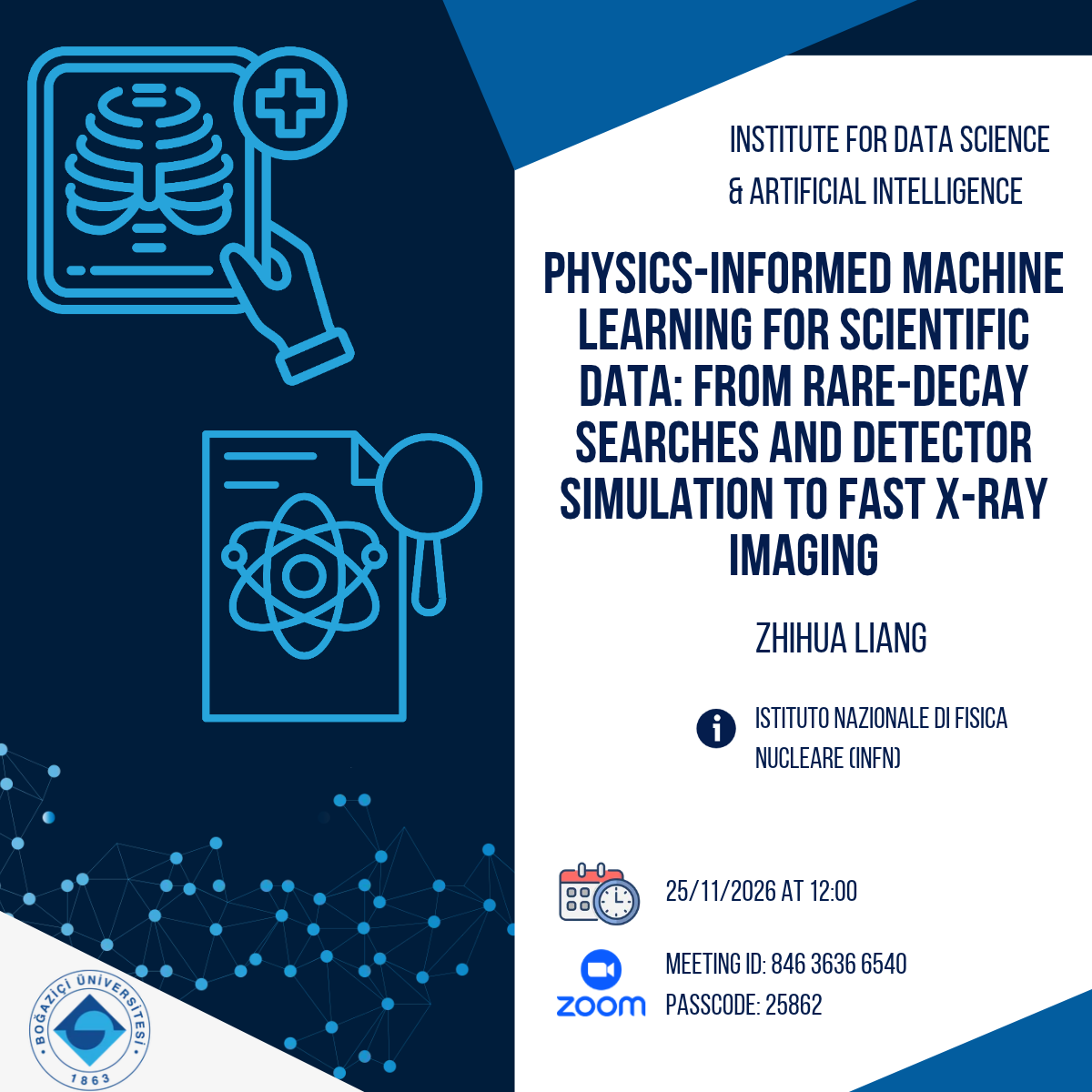
Speaker: Zhihua Liang Affiliaton: Istituto Nazionale di Fisica Nucleare
Abstract: Scientific data carry structure (symmetries, geometry, known physical response) that generic deep-learning models ignore. In this talk I present a line of work that builds such structure directly into learning systems. First, I introduce PIG-HA Net, a physics-informed graph hierarchical-attention architecture I developed for the LHCb B_s→ττ search, reaching about 40% signal efficiency at a 10⁻⁴ background retention rate in benchmark evaluation. Second, I describe a machine-learned detector-response model for the TimeSPOT silicon sensor that runs roughly 5×10⁴ times faster than the reference calculation and is integrated into the LHCb C++ simulation chain. Third, I discuss deep learning for X-ray/CT imaging and industrial defect detection, including spin-off work at the University of Antwerp. I close with future directions: geometric and physics-constrained foundation models for scientific and medical imaging, and verifiable AI, in which machine-checked proofs (Lean 4) are used to audit model-assisted reasoning.
Bio: Zhihua Liang received his B.Sc. from Tsinghua University and his Ph.D. in physics from Southern Methodist University (2012). He was a postdoctoral fellow at the University of Houston (X-ray phase-contrast imaging), a researcher at the University of Antwerp, where he led machine-learning work for X-ray CT and additive-manufacturing inspection and co-founded the spin-off DeltaRay, and a researcher at INFN Cagliari on the LHCb experiment at CERN (2023–2026). His research combines physics-informed and geometric machine learning, fast inference for detector systems, imaging, and formal verification.
https://us06web.zoom.us/j/
MEETING ID: 84636366540
PASSCODE: 25862