





Deciphering Gene Regulatory Logic through Interpretable Deep Learning
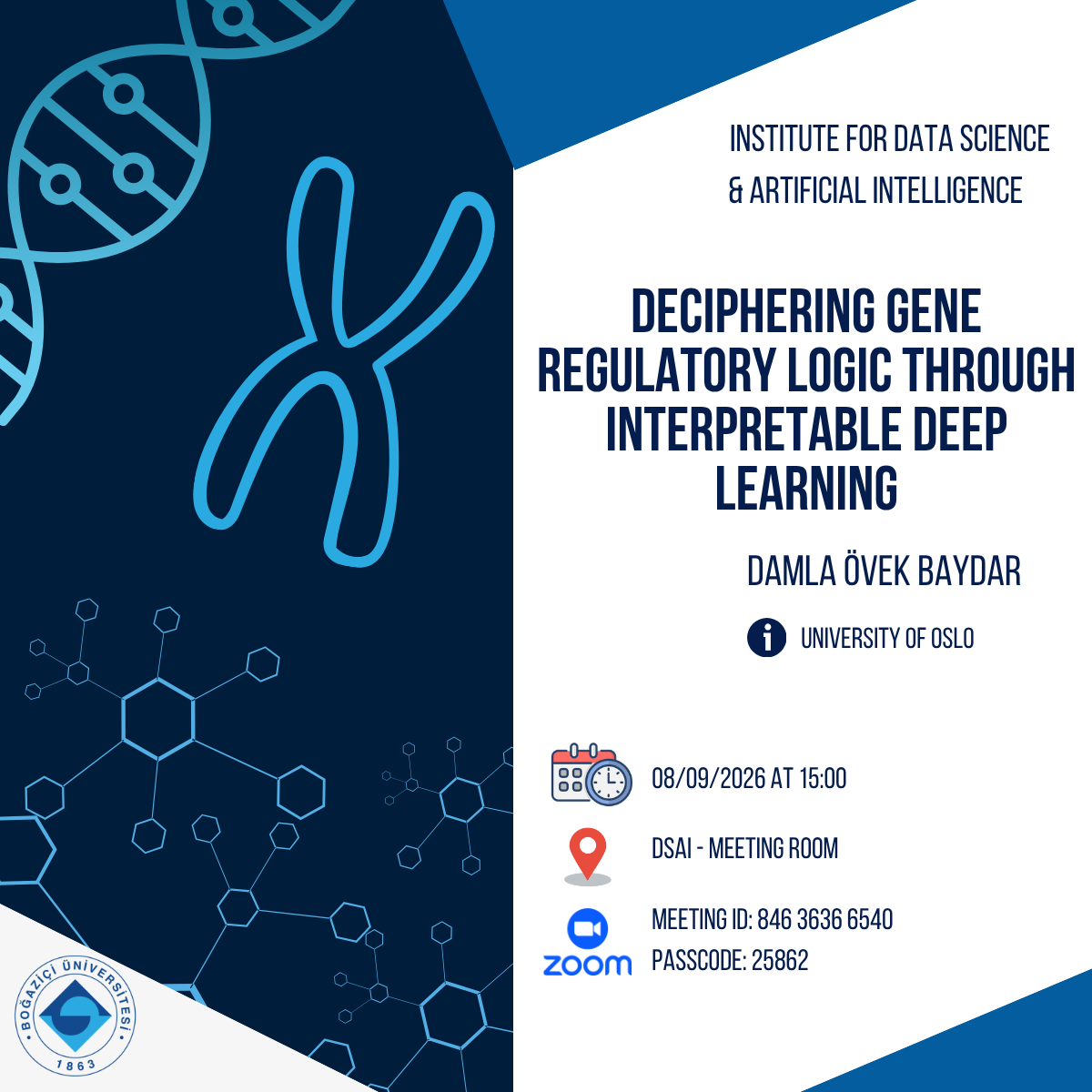
Speaker: Damla Övek Baydar
Abstract: Transcriptional gene regulation governs cellular identity by translating the static genomic sequence into dynamic gene expression programs. A key component of this process is transcription factors (TFs), which regulate transcription by binding to cis-regulatory elements such as promoters and enhancers. Deciphering the regulatory logic of TF-DNA interactions remains a central challenge, as TF binding is governed by complex, context-dependent interactions that extend beyond canonical sequence motifs. Traditional models, such as position frequency matrices, fail to capture these combinatorial and structural dependencies. In this talk, I will present how interpretable deep learning models can learn high-resolution, context-aware representations of TF binding directly from genomic sequence. I will describe my work on developing scalable computational pipelines and database infrastructure to train, interpret, and integrate these models into JASPAR, an international, open-access, community-driven database and an ELIXIR core data resource. I will further discuss how model-derived representations enable systematic characterization of regulatory grammar across cellular contexts. Finally, I will outline my research program, which aims to develop multimodal and interpretable deep learning frameworks, along with computational tools and databases, that integrate sequence, structural, and chromatin features to uncover the mechanistic basis of gene regulation and its perturbation in disease.
Bio: Damla Övek Baydar is a postdoctoral researcher at the Norwegian Centre for Molecular Biosciences and Medicine (NCMBM) at the University of Oslo, where she works at the intersection of artificial intelligence, interpretable deep learning, and regulatory genomics. Her research focuses on modeling the complex logic of transcription factor-DNA interactions, leveraging interpretable sequence-to-binding-profile models and transforming these models into accessible, community- scale resources. She received her PhD in Computer Science and Engineering from Koç University in 2024, where her work focused on deep learning approaches for modeling protein-protein interactions. She also holds an MSc in Computational Sciences and Engineering and a BS in Molecular Biology and Genetics, with a double major in Computer Engineering, from Koç University. Her long-term research aims to develop interpretable and multimodal AI methods that advance our understanding of gene regulation and enable biologically grounded discoveries.
https://us06web.zoom.us/j/
MEETING ID: 84636366540
PASSCODE: 25862